Category Archives: Cloud Platforms

Openstack Juno services – Swift, Glance, Heat, Ceilometer

This blog is part of my series on Openstack Juno. In this blog, I will cover the usage of Openstack services Swift, Glance, Heat, Ceilometer.

Swift:

Swift is used for Object based storage. Its similar to AWS S3 service.
First, create a container to store objects:

$ swift post mycont

Upload a file to the container

$ swift upload mycont local.conf

List container and objects.

$ swift list
mycont
$ swift list mycont
local.conf

List status of created container.

Continue reading Openstack Juno services – Swift, Glance, Heat, Ceilometer

Openstack Juno services – Nova, Cinder

This blog is part of my series on Openstack Juno. In this blog, I will cover the usage of Openstack services Nova, Cinder.

I found this blog on Openstack services good in giving a highlevel overview of services and comparing individual Openstack services with Amazon AWS services.

Nova basics:

Nova is the Openstack compute service.
Following command shows the flavors available by default. Flavors are different configurations(CPU, memory, hard disk) for the VMs that can be created from Nova.

Continue reading Openstack Juno services – Nova, Cinder

Openstack Juno Install using Devstack

Earlier, I had written 2 blogs on Openstack devstack Icehouse installation and networking. The feedback was positive on these blogs. This prompted me to do a series on different aspects of Openstack Juno. Openstack Juno is the 10th and latest release of Openstack that got released in October 2014. In the next series of blogs, I will cover the following aspects of Openstack Juno.

  • Openstack Juno devstack installation and debugging.
  • Accessing Openstack services through CLI, API and SDK.
  • Overview of different Openstack services along with a demo of their usage.
  • Multi-node devstack installation.

In this blog, I will cover the steps to install Openstack Juno in Devstack.

My environment:

  • Windows 7 with Virtualbox 4.3.20
  • 24 GB RAM (Devstack install per VM requires a minimum of 4GB)

Installation steps:

Continue reading Openstack Juno Install using Devstack

Docker Orchestration

This blog is part of my ongoing series on Docker containers. Orchestrating Containers is a pretty complex task and there is a lot of work ongoing to solve this particular problem. There are big companies, startups as well as Opensource projects involved with this work. There are many different technologies and projects ongoing that got me really confused when I started looking at this. In this blog, I have tried to break down the Docker orchestration problem into smaller pieces and have tried to map different existing/developing solutions into the smaller pieces. Considering that the technologies are evolving and that my knowledge in this area is limited, this blog might need updates and corrections as we move forward. Also, I might have missed few technologies as well as companies..

Problem statement:

Docker does a great job in packaging and transporting single containers. Following are specific problems we need to address:

  • Distributed Applications split between multiple containers.
  • Manage a large number of containers both in terms of allocating the containers to the cluster of hosts as well as handling container failures.

Orchestration blocks:

Continue reading Docker Orchestration

Group based policy in Opendaylight

This is a continuation of my previous blog on Group based policy(GBP). In this blog, I will cover the GBP features in Opendaylight helium release, Use-cases that are published in the Opendaylight wiki as well as different usecase that I tried out.

Group based policy in Opendaylight:

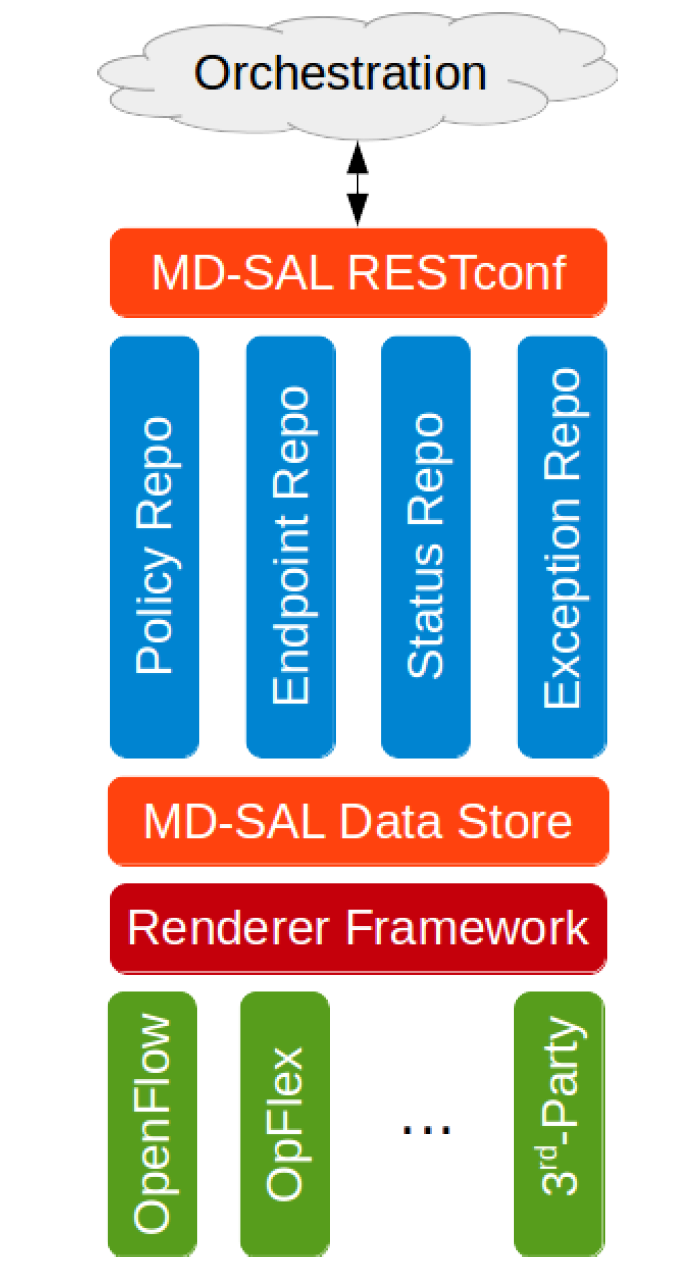
Following diagram is from Opendaylight GBP wiki:

gbp3

  • Openstack here is the orchestration layer and it communicates the policy to ODL through Neutron apis.
  • The policy is expressed in high level data language and is translated and programmed into hardware through renderers.
  • In ODL helium release, the only available renderer is Openflow and it uses ovsdb overlay design.
  • Opflex renderer is being developed currently and it is also based on ovsdb overlay. When Opflex is available, there will be a Opflex agent in the openvswitch that will eventually do the low level translation and programming.

Continue reading Group based policy in Opendaylight

Group based policy

There is lot of work going on in both Openstack and Opendaylight projects on Group based policy and I will try to capture my learnings in the next few blogs.

Group based policy(GBP) is an abstracted way of specifying interactions between the applications rather than using infrastructure specifics. In the networking context, for example, rather than using terms like ip address, vlan, port numbers, the policies are specified in much higher level language in terms of what the application needs. Currently Group based policy is targeted for Networking. Eventually, it will be applicable to Compute and Storage as well. I kind of see GBP as Open source variant of Cisco’s ACI model, multiple vendors are involved in the development of GBP.

In Openstack Neutron context, following are the goals of Group based policy.

Continue reading Group based policy

Recent Networking Opensource projects – OPNFV, Openconfig, ONOS

I came across few recent Opensource projects which I found them to be interesting. In this blog, I will cover some details on OPNFV, Openconfig, ONOS. There is no relation between the 3 projects, the common thing is all the 3 projects are focussed on Networking and Cloud and all are relatively new.

OPNFV

OPNFV is an Opensource project under Linux foundation. The goal is to create a Opensource reference platform for developing NFV applications. In 1 of my earlier blogs on NFV, I covered overview of NFV and the ETSI NFV model. The goal of the OPNFV project is to create a reference implementation using the model proposed by ETSI. OPNFV’s plan is to leverage the work done in other Opensource projects like Openstack, Opendaylight, Openvswitch, KVM, Linux kernel, DPDK. Even though OPNFV can work with other Cloud OS and SDN controllers, the goal for the first release is to use the most popular Cloud OS, SDN controller and hypervisor mentioned above. Following picture from OPNFV illustrates the blocks that OPNFV will focus on from ETSI NFV reference model.

Continue reading Recent Networking Opensource projects – OPNFV, Openconfig, ONOS

Openstack distribution

In the last few months, following were some acquisitions that happened: Cisco acquiring Metacloud, EMC acquiring Cloudscaling, HP acquiring Eucalyptus. Metacloud and Cloudscaling have Openstack based distributions, Eucalyptus has a cloud OS similar to Openstack. This set of acquisitions prompted me to look little closely at Openstack distributions and following blog is a result of this.

I see a close parallel between Linux and Openstack in terms of how they are evolving. Unix started off with various flavors like FreeBSD, Solaris, Linux etc. Linux is the dominant Unix version used now. There are different companies like Redhat, Ubuntu selling and supporting Linux distributions. There are currently different Cloud OS like Cloudstack, Eucalyptus, Openstack etc. Openstack is emerging as a major Cloud OS. There are different companies selling Openstack distributions currently.

Continue reading Openstack distribution

Storage Primer

Storage is a very critical component in the current IT domain. Choosing the right Storage platform and software is a critical part of a good Data center whether it is internal or external cloud. Even though I understood some Storage basics, I never ventured deep to understand the different storage technologies available. I tried to brush up my knowledge by doing some reading recently and I have tried to capture some of my reading in this blog.

Storage device(HDD vs RAID vs SSD)

HDD – Hard disk drive consists of a spindle with disks.

RAID(Redundant array of Independent disks) – Combines multiple HDDs to provide more reliability, throughput and capacity.

SSD – Solid state drive is a memory chip and it has no moving parts.

Storage device performance is measured in terms of throughput(data transfer rate), latency(time it takes to start a IO task) and IOPS(IO operations per second).  SSD scores better over HDD on all the performance parameters. RAID provides comparable throughput and IOPS as SSD, but SSD provides better latency. The only disadvantage of SSD is the much higher cost.

Continue reading Storage Primer

SDN Openflow commercial applications – Part 2

This blog is a continuation from my previous blog on SDN Openflow commercial applications. In this blog I will cover SDN applications in Network performance optimization and monitoring and Data center fabric.

Network performance optimization and monitoring

Networks have a lot of information and by looking at Network state and statistics collectively rather than at individual device level provides a lot of useful information. This information can be used to optimize the network based on application needs. The next set of applications are targeted towards monitoring Network state and statistics as well as improving the performance of the network.

Kemp SDN Adaptive load balancer

Kemp has integrated its Load master ADC with HP VAN SDN controller to provide adaptive load balancing based on the traffic load on the switches.  Normally ADC makes load balancing decisions based on L4-L7 characteristics. Kemp’s Load master ADC interacts with HP VAN SDN controller which in turn gets the traffic load on switches using Openflow. Based on the L2/L3 network statistics and the L4-L7 characteristics, Kemp’s Load master makes intelligent decisions on traffic steering and load balancing.

Continue reading SDN Openflow commercial applications – Part 2