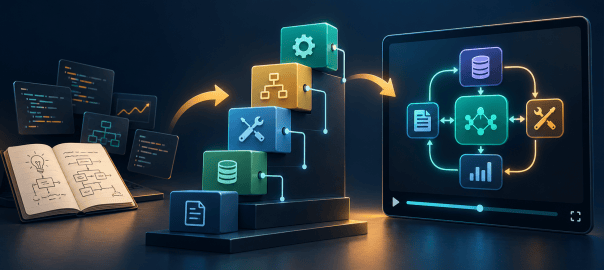
I recently published my course, “Inside AI Agent Systems: From Components to Platforms”, on Udemy. It brings together what I’ve been learning about AI agents through professional work, personal projects, and experiments over the past few years.
Prefer to watch? Here’s the video version of this post.
How I Learn
There is plenty of material available on AI. What I’ve found valuable is a structured path: understand a concept, apply it, and build on what I’ve learned.
Ed Donner’s AI Engineer Core, Production, and Agentic tracks helped me strengthen my fundamentals and connect them to practical work. That progression influenced how I designed my own course.
Alongside courses, I follow blogs, podcasts, and YouTube videos to keep learning. I put ideas into practice through projects I’ve worked on, such as SignalLoop, which explores AI-assisted coding assessments, and AI Model Factory, part of Model Academy, which helps explain how AI models are built and produce answers.
My blog is another part of that process. I document experiments—what I tried, what worked, what didn’t, and what I learned. Writing helps me clarify my understanding. Creating this course was a way to organize those experiences into a learning path others could follow.
From Foundations to Practical Choices
Frameworks and platforms make it easier to build agents. I still believe understanding the foundations matters: how components interact, why an agent behaves a certain way, and how to investigate when something goes wrong.
I’ve also explored representative tools available for individual components and complete agent systems—from agent frameworks and agentic platforms to monitoring, tracing, evaluation, and persistent memory tools. The goal is to connect each capability to practical options and help learners reason about which choices fit their needs.
The course uses one Marketplace application as a common thread. Buyers, sellers, and a support agent provide the setting. We start simple and explore additional capabilities, following a practical cycle: configure, run, inspect, and compare. For example, change retrieval or session-history settings, ask a question, and inspect the answer and execution trace to understand what changed.
Different audiences can choose their depth. Developers can explore the code and labs. Technical architects can examine architecture and design patterns. Product managers can consider requirements and trade-offs, while business leaders can explore practical applications.
My goal is to help learners understand how agent components work together and assess emerging capabilities. The course also compares representative agent frameworks, agentic platforms, and tools for capabilities such as monitoring, evaluation, and tracing, helping learners make informed choices for their use case.
Keeping It Relevant
I’ve also explored frontier topics such as model routing, agent design patterns—including agent swarms—and persistent memory. The aim is to help learners consider when these capabilities are useful and what additional complexity they introduce.
AI tools and platforms change quickly. Some implementation details will need updating, and my intention is to actively revisit the material over the next three to six months. The foundations are the part I hope learners can continue to build on as the tools evolve.
How AI Helped Me Create the Course
AI made the course-creation process easier, too. I used it to brainstorm content, research topics, and develop course material. Coding agents helped me build, debug, and evaluate the course code. AI also assisted with video editing and repetitive publishing tasks, including Udemy uploads, descriptions, and summaries. It reduced the effort involved in turning ideas and experiments into a finished course, while I remained responsible for the content, validation, and final decisions.
Creating this course also taught me how to produce video content. I hope to bring that learning back to my blog, making future posts more interactive and combining writing with visuals, demonstrations, and video.
Explore the Course
If learning from foundations through practical experiments fits your approach, you can explore the course and its free previews on Udemy.
Drafting assistance: Codex helped organize and edit this post from my account of the learning process and course design.

