Objective
An enterprise agent can run in one cloud, call a model in another, and use an internal tool to update a business record. Choosing a governance platform means knowing which parts of that workload it can see and where it can enforce a rule. I compare Lyzr, Credo AI, Holistic AI, Google Cloud, and Microsoft by the governance capabilities they offer and how broadly those capabilities apply.
The earlier posts covered responsible AI, how to evaluate models and agents, and how to turn governance principles into an entity model and a working prototype. I use the Marketplace Assistant from my AI Agents for Production course on Udemy to show where each platform could stop an unauthorized refund before it goes through. Responsible AI · Evaluation · Governance principles · Governance prototype
What Should an AI Governance Platform Do?
I compare what each platform can do and how broadly those capabilities apply across policies, systems, platforms, and industries.
What capabilities does the platform offer?
- Discovery and ownership. Find the agents, models and tools in use. Show who owns each one and which assets must be registered manually.
- Policy management. Define a rule, approve it and attach it to the right agent or resource. Record who can approve an exception and when it expires.
- Monitoring and evidence. Show which policy version was active, what decision it produced, and who followed up. A dashboard showing that a rule is enabled answers only the first question.
- Enforcement. Identify the component that can stop, limit or hold an action before it takes effect. That component might belong to the platform, the cloud provider or the application team.
How broad is their coverage?
- Policy coverage. Which kinds of rules can the team express and apply? Access permissions, sensitive-data handling, spending limits and human approval address different risks.
- What the platform governs. Which objects can those rules govern? Look separately at cloud infrastructure, models, agents, tools and the business records they can change.
- Integration and cross-platform reach. How does the platform connect to an agent on another stack, and what can it do there? Reading another gateway’s logs and configuring that gateway to block a call provide different levels of control.
- Industry coverage. What comes ready to use for a regulated workflow? A sector policy template helps define requirements. A configured control and its decision record show how a specific requirement is applied.
Follow One Request
Suppose a buyer asks the assistant to refund an order. The application can have permission to invoke the assistant. The assistant can have permission to call a model. The model can even suggest the right refund tool. The critical decision still lies ahead: who checks whether this agent can execute the refund?
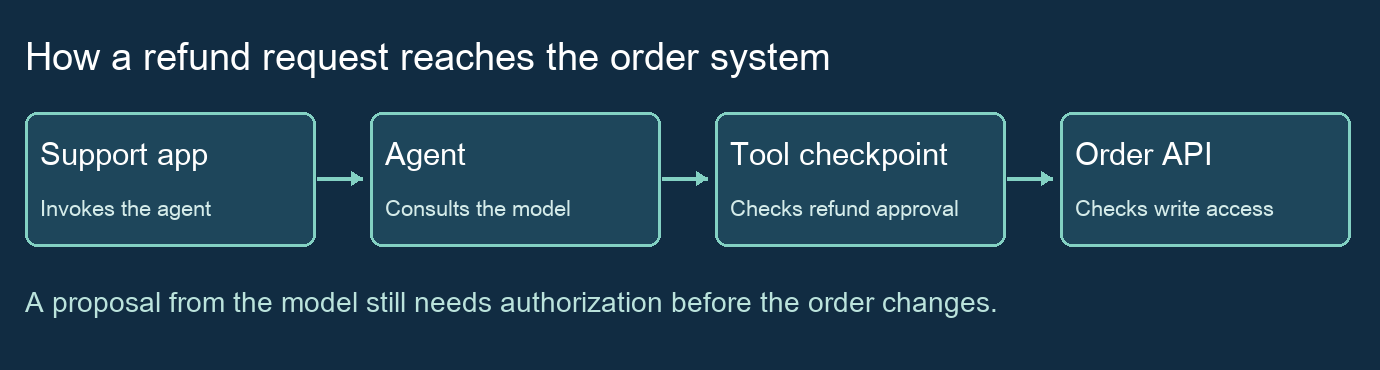 The model proposes an action. The tool checkpoint and the order API can each enforce a rule before money moves.
I use two questions throughout. In the control plane, who registers the agent, owns its policy and approves an exception? In the data plane, which component sees the actual request, and can it stop it? Monitoring connects them. A configuration record tells me the rule was attached. A decision record and an unchanged order tell me what happened.
What Each Platform Supplies
Lyzr OpenController
Teams can build agents in Agent Studio and deploy them on-premises. OpenController can monitor and govern integrated agents across clouds and on-premises, including agents built outside Lyzr. I would verify the specific on-premises configuration with the vendor and in a proof of concept. Agent Studio deployment options · OpenController on-premises example · Deployment considerations
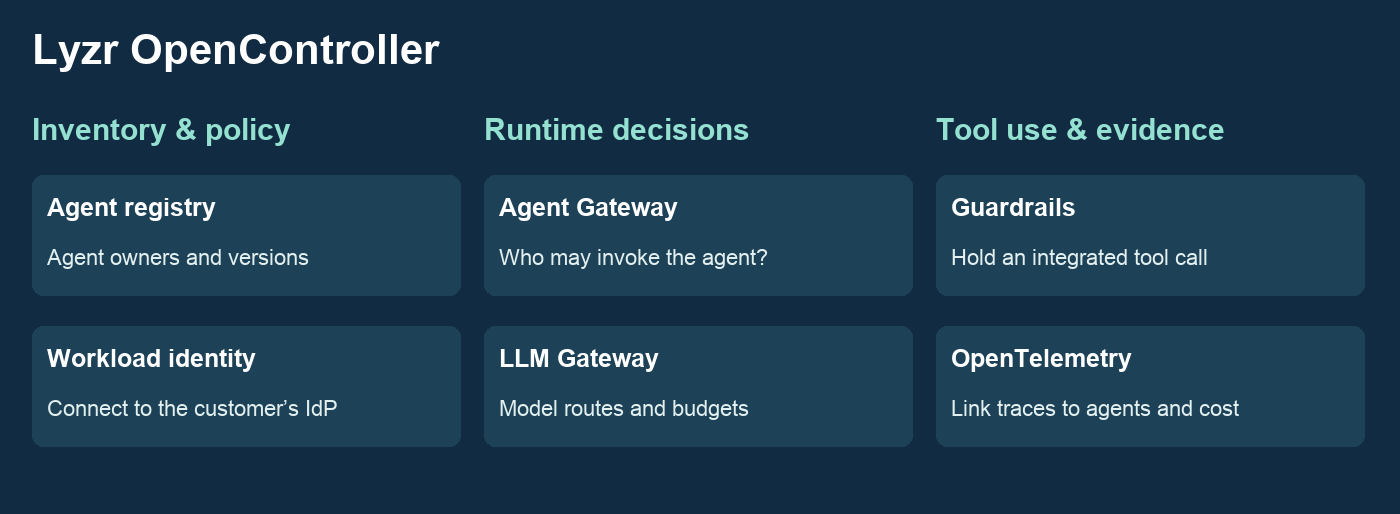 Incoming agent requests, outgoing model calls and tool execution have distinct checkpoints.
Lyzr starts with a fleet of agents. Its registry records owners, versions and tools. Its Agent Gateway checks incoming callers. Its LLM Gateway routes outgoing model requests and applies configured limits. For the refund, the relevant component is Guardrails. Lyzr describes an integration that checks a tool call before execution and can hold it for approval. For an existing agent on another cloud, I would trace the actual tool path to confirm it passes through that checkpoint. OpenController components · Tool-call integration
Strength. It can bring integrated, containerized agents across clouds and on-premises under common inventory, access, and spending controls.
Limitation. Direct policy delivery to a customer’s existing third-party gateway remains unverified.
My take. I’d shortlist Lyzr when I need to discover, monitor, and manage agents across multiple clouds and on-premises.
Credo AI
Credo AI focuses on AI governance for enterprises. It helps organizations register AI uses, assess risk, approve policies, and retain evidence.
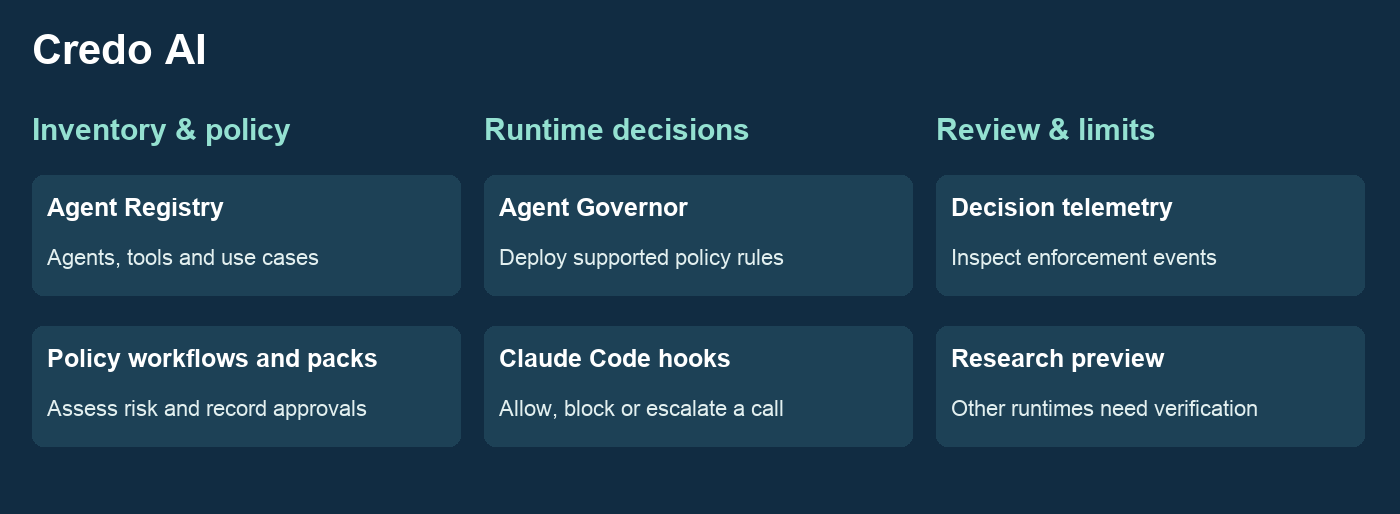 Credo connects governance workflows to action checks in a supported agent harness.
Credo starts with the governance team’s work. The AI Registry tracks the AI portfolio, including each agent’s purpose, tools, and data sources. Policy workflows guide teams from submitting a proposed AI use through review and approval. Policy packs give reviewers a reusable set of requirements to check. Agent Governor addresses a separate job: checking an action inside the software running the agent. Its research preview supports Claude Code hooks that can allow, block or escalate a proposed tool call. I would count that for a supported coding agent. Applying it to the Marketplace agent requires a supported hook in that runtime. Registry and policy packs · Agent Governor
Strength. Structured reviews and reusable requirements support consistent approvals across teams.
Limitation. Agent Governor’s research preview starts with Claude Code. I couldn’t verify that Agent Governor can enforce policies for agents built on other platforms.
My take. I’d shortlist Credo when a governance team needs consistent policy reviews and approvals across business units.
Holistic AI
Holistic AI helps risk teams find the AI tools people use, assess their risks, and monitor what happens after deployment.
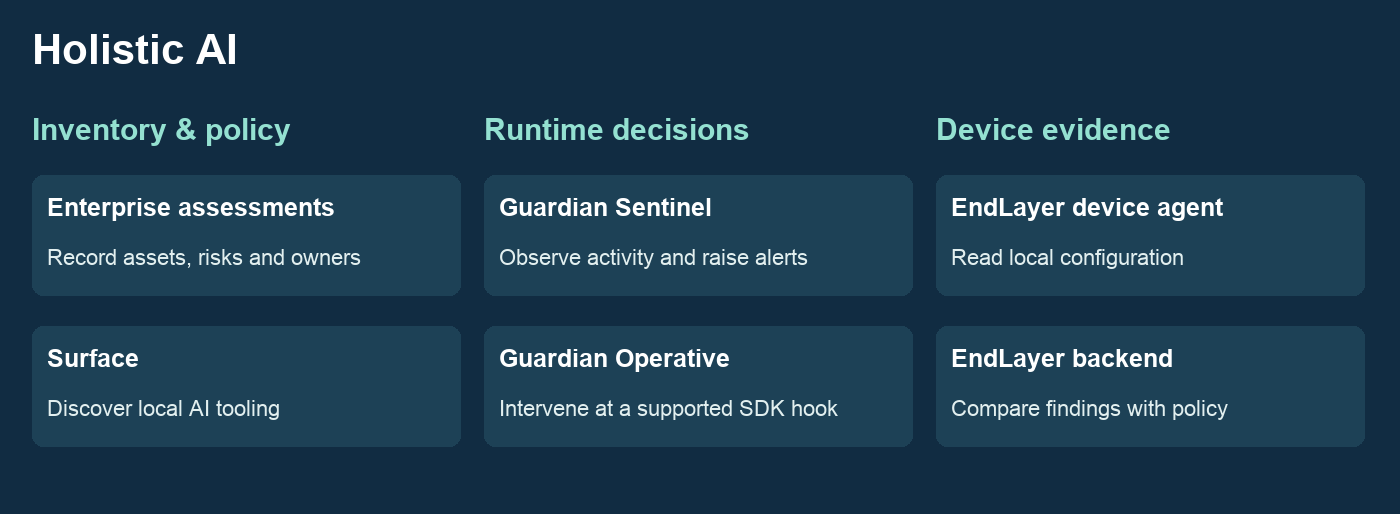 Guardian agents observe or intervene. EndLayer reports the state of a device.
For a running agent, Holistic AI offers Guardian Agents. Sentinel Agents observe activity and raise alerts. To enforce a rule, the team routes the agent’s tool calls through Holistic AI’s Guardian SDK so Operative can block a risky call before it runs. For the Marketplace case, I would look for the Operative decision before the refund executes. A Sentinel alert supplies useful evidence even when it arrives too late to prevent a write. Guardian Agents
On an employee’s computer, two tools answer different questions. Surface finds supported AI tools installed on that computer. EndLayer checks how those tools are configured and flags differences from company policy. Its technical overview lists cross-layer enforcement as planned, so I credit that evidence under monitoring. Surface · EndLayer technical overview
Strength. Its assessments, device discovery, and runtime observations help reviewers connect an inventory entry to evidence of actual use.
Limitation. Seeing an alert tells the team what happened. Blocking an action requires a supported connection to Operative.
My take. I’d shortlist Holistic AI when the priority is finding AI use, assessing its risk, and monitoring what happens after deployment.
Google Cloud
Google Cloud offers an enterprise platform for building and running agents. Its governance tools are a natural fit for teams whose agents already run on Google Cloud.
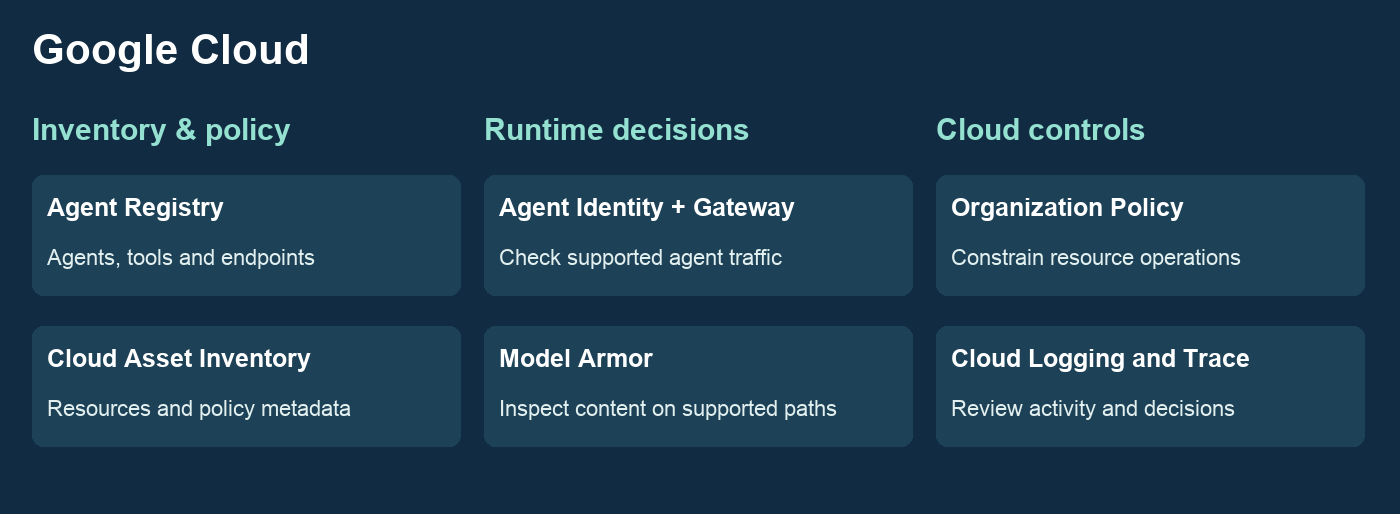 Resource constraints, agent access checks and content controls operate at different points.
Google separates cloud resources from agent activity. Cloud Asset Inventory shows infrastructure and policy metadata. Organization Policy can restrict a resource operation, such as deployment in an unapproved region. At the agent layer, Agent Registry catalogs endpoints, Agent Identity identifies the caller, and Agent Gateway governs supported traffic. Model Armor inspects supported content. The application team still needs to show where the order service checks refund permission. Agent governance · Organization Policy
An agent can also run on Kubernetes outside Google Cloud, for example on Amazon EKS or Azure AKS. In the limited preview, the team installs Google’s Agent Gateway proxy in that cluster and routes agent traffic through it. The team defines policies in Google Cloud. The proxy enforces them on the requests it receives. Cross-cloud gateway
Strength. Resource policies, agent identity, gateway decisions, and cloud logs can give a Google Cloud team control and evidence in its existing environment.
Limitation. Cross-cloud enforcement requires traffic to pass through Google’s proxy. An existing gateway can forward requests to it.
My take. I’d start with Google Cloud for a Google Cloud deployment and test the proposed control path for each external workload.
Microsoft
Microsoft Foundry gives teams a platform to build, deploy, and run agents. Microsoft’s identity, data protection, and cloud management tools provide additional governance controls.
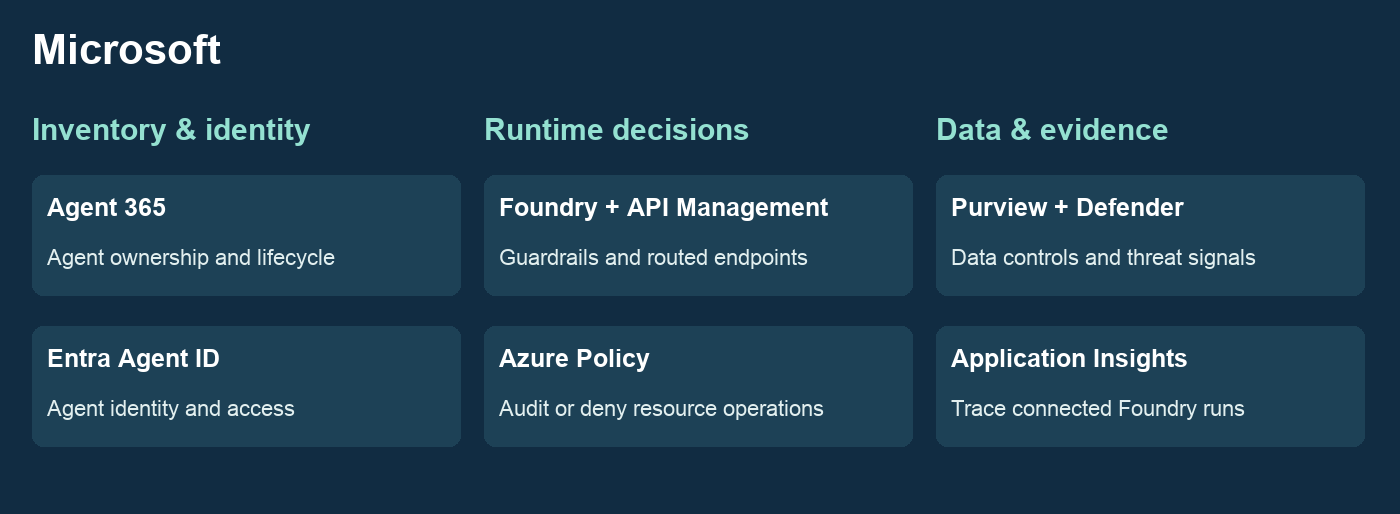 Tenant inventory, Azure controls and runtime telemetry cover different parts of the same workload.
Agent 365 gives enterprise teams a registry and ownership view. Entra Agent ID supplies identity and access controls. Foundry governs supported AI workloads, Purview helps teams identify sensitive data and set rules for how supported applications can use or share it, and Application Insights captures connected traces. Azure Policy can deny applicable infrastructure changes. These controls act at different moments in the same deployment. Agent 365 · Foundry governance
Microsoft’s tool documentation makes the integration work unusually clear. If the refund tool is exposed through Model Context Protocol (MCP), the team must configure the tool to call the gateway-routed endpoint. Foundry MCP routing
Strength. Agent 365 shows who owns an agent. Entra Agent ID gives the agent an identity that administrators can use to control its access.
Limitation. To enforce API policies locally in another cloud with Azure API Management, the team must deploy Microsoft’s self-hosted gateway there and route the relevant calls through it.
My take. I’d start here for an enterprise already operating in Azure and Entra, then verify the integrations and licenses needed for its workload. Microsoft also offers a self-hosted Azure API Management gateway. Teams can deploy it in another cloud and enforce supported policies on requests routed through it.
How the Platforms Compare
AI governance tools come from specialists, cloud providers, and enterprise workflow platforms. I selected five from that wider market, including three specialists and two major cloud providers. I reviewed vendor websites, product documentation, and relevant external references. I couldn’t get the trial access needed to test all five side by side, so the ratings may favor better-documented capabilities. High means broad coverage with concrete mechanisms. Medium means useful coverage with a material scope, integration or preview limit. Low means narrow or indirect coverage for that particular job. Missing evidence remains an open question. Releases and terms can change.
| Governance question | Lyzr | Credo AI | Holistic AI | Google Cloud | Microsoft |
|---|---|---|---|---|---|
| Discover assets and owners | High | High | Medium | High | High |
| Manage policies and approvals | Medium | High | Medium | High | High |
| Monitor and retain evidence | Medium | Medium | Medium | High | High |
| Enforce rules on supported paths | Medium | Low | Medium | Medium | High |
| Cover different policy areas | Medium | High | Medium | High | High |
| Govern infrastructure, AI systems and agents | Medium | Medium | Medium | High | High |
| Govern agents across platforms | High · includes on-premises | Medium | Medium | Medium | Medium |
| Supply industry-specific controls | Low | Medium | Low | High | High |
The same vendor can score differently for policy and enforcement. Credo’s workflows address who approves a use case and what evidence a reviewer needs. Its documented runtime preview covers a narrower set of agents. Microsoft’s enforcement grade reflects multiple control points within supported, configured paths. It makes no prediction about an unconnected Marketplace tool.
Cross-platform reach depends on the action. An SDK, an agent-to-agent protocol connection or a gateway endpoint explains how a system connects. The stronger question is whether the controller can apply a rule and show its effect on that external system. Lyzr documents agent governance across customer-managed stacks. I could not establish from the reviewed sources that any of the five can push a policy directly to an arbitrary third-party gateway already in place.
Sector coverage also needs a concrete example. A financial-services policy template helps a reviewer decide which evidence to request. A cloud control package can constrain eligible services in a regulated environment. For a particular workload, I would check which services, records and regions the package actually covers. Google Assured Workloads · Microsoft healthcare compliance scope
Discovery and policy management
| Provider | Discover assets and owners | Manage policies and approvals |
|---|---|---|
| Lyzr | High · OpenController scans for agents and registers owners, tools and versions. | Medium · Configure routed access, spend limits, guardrails and release gates. |
| Credo AI | High · Agent Registry links agents, tools, MCP servers and deployment platforms to use cases. | High · Credo policy workflows and packs support intake, assessments and approvals. Custom uploads to Agent Governor are forthcoming. |
| Holistic AI | Medium · Discovery through connected cloud, data and developer sources. Surface for supported local signals. | Medium · Risk workflows and safeguards. Verify custom rule authoring and deployment bindings. |
| Google Cloud | High · Agent Registry catalogs agent endpoints and tools. Cloud Asset Inventory tracks infrastructure and policies. | High · Organization Policy sets resource constraints. IAM sets access rules. Model Armor templates configure content checks. |
| Microsoft | High · Agent 365 tenant inventory. Foundry inventory for supported AI workloads. | High · Azure Policy initiatives, Entra Agent ID access controls, Foundry guardrails and Purview data policies. |
Monitoring and evidence and enforcement
| Provider | Monitor and retain evidence | Enforce rules on supported paths |
|---|---|---|
| Lyzr | Medium · OpenController uses OpenTelemetry traces for agent activity, ownership and cost. Verify policy-version linkage. | Medium · Agent Gateway checks callers. LLM Gateway routes models. Integrated tool guardrails can hold a refund for approval. |
| Credo AI | Medium · Approvals, audit evidence and separate Governor decision telemetry. Check linkage. | Low · Agent Governor provides runtime guardrails for tool use at supported harness hooks. A registry entry alone does not gate a call. |
| Holistic AI | Medium · Guardian Sentinel Agents observe and alert. EndLayer compares device configuration with policy and records findings. | Medium · Guardian Operative Agents intervene via Guardian SDK hooks. Verify the decision precedes the tool write. EndLayer cross-layer enforcement is listed as planned. |
| Google Cloud | High · Cloud Asset Inventory shows configuration. Cloud Logging and Trace supply runtime evidence. Dry-run violations show simulated decisions. | Medium · Org constraints at resource operations. IAM and Agent Gateway on supported agent routes. Model Armor on supported content paths. |
| Microsoft | High · Agent 365 shows activity. Application Insights stores connected Foundry traces. Defender supplies threats and Purview supplies audit signals. | High · Azure Policy at resource operations. Azure API Management on routed calls. Foundry guardrails and configured Purview controls on supported workloads. |
Policy coverage and what the platform governs
| Provider | Cover different policy areas | Govern infrastructure, AI systems and agents |
|---|---|---|
| Lyzr | Medium · Operational access, spend, guardrails, quality and release. Broad enterprise risk scope open. | Medium · Agent fleet operations. Cloud resource and general AI case coverage need separate evidence. |
| Credo AI | High · Risk, regulatory mappings, third parties and evidence. Runtime coverage depends on Governor hooks. | Medium · Enterprise AI governance plus agent assets and a separate harness enforcement preview. |
| Holistic AI | Medium · Risk, privacy, testing and monitored intervention. Product-specific deployment coverage open. | Medium · Enterprise AI and agent governance with SDK, endpoint and discovery mechanisms. |
| Google Cloud | High · Resource configuration, access, data, traffic and agent behavior by service. | High · Cloud resources, models and agents through separate services. Cross-cloud gateway limited preview in governance docs. |
| Microsoft | High · Resource compliance, identity, data and AI safety across Azure and Microsoft 365. | High · Azure resources and AI workloads plus enterprise tenant agents and identities. |
Cross-platform reach and industry
| Provider | Govern agents across platforms | Supply industry-specific controls |
|---|---|---|
| Lyzr | High · SDK and gateways support integrated agents across clouds and on premises. Verify monitoring and enforcement on your stack. | Low · Industry use cases. Sector controls and approval artifacts require verification. |
| Credo AI | Medium · Registry spans deployment platforms. Governor runtime coverage starts with Claude Code. | Medium · Documented sector policy packs, including financial services. Test actual workflow and rule binding. |
| Holistic AI | Medium · Discovery connectors, endpoint scans and Guardian SDK span environments. Verify each runtime hook. | Low · Insurance use cases and sector material. Verify whether reusable controls and evidence ship. |
| Google Cloud | Medium · Google gateway on external Kubernetes, including EKS and AKS, is in limited preview. | High · Assured Workloads control packages on eligible cloud services. Verify downstream service and data scope. |
| Microsoft | Medium · Agent 365 inventories supported external agents. Foundry connects remote A2A endpoints. Coverage depends on registration and integration. | High · Azure compliance offerings and initiatives, such as HIPAA/HITRUST. Verify services, tenant and configuration. |
Where Should Enforcement Happen?
I would ask each provider to demonstrate the same Marketplace workflow. These are the decisions and evidence I would look for in that demonstration. For each decision, I’d check who supplies the control and who operates it. It might be the platform vendor, a third-party gateway provider, or the team that owns the API.
| Policy | Enforcing component | When it acts | Evidence |
|---|---|---|---|
| Use approved regions | Cloud resource service | At resource creation | Denial identifies the region. No resource was created there. |
| Release after checks pass | Pipeline release gate | Before promotion | A failed check leaves the previous version live. |
| Issue credentials to approved agents | Identity service | At token request | The decision names the principal and grant. |
| Admit only the support app | Agent gateway | Before agent invocation | The unauthorized caller is denied before the agent runs. |
| Use approved models | LLM gateway | Before forwarding a model request | One approved call succeeds and one disallowed call is denied. |
| Get approval for a consequential refund | Runtime guardrail | Before the tool runs | A pending approval holds the action until review. |
| Keep the support agent read-only | Runtime guardrail and order API | Before tool execution and before writing the record | Test each control independently. Lookup succeeds and the refund record stays unchanged. |
The last row is the one I would spend time on in a demo. First, show that the agent can read the order. Next, show where the refund request stops. If the guardrail stopped it, the API never received the request, so that run tells me nothing about the API’s own authorization. A separate check with the same read-only identity can establish that second control. I would keep the active policy version, the decision and the resulting order state together.
Which Platform Would I Start With?
If my agents use a managed agent platform in one cloud, I’d start with that provider’s built-in controls. For agents across clouds or on-premises, I’d shortlist platforms based on the work my team needs to do.
- Lyzr for agent fleet operations. Discover, monitor and manage agents across clouds and on-premises.
- Credo AI for policy management. Assign owners, review policies and gather audit evidence across teams.
- Holistic AI for assessment and intervention. Assess risk, observe agent behavior and intervene on selected actions.
I would use the scorecard to build a shortlist, then run a proof of concept on my own stack. I would choose based on where each platform can enforce my rules and what evidence it leaves for reviewers.
Summary
This article compared five AI governance platforms by what they govern, where they can enforce a rule, and how far their controls reach. I used the Marketplace Assistant’s refund workflow to show where a rule can take effect and what evidence a reviewer can use to verify the decision.
Acknowledgements
I used OpenAI Codex to help review provider documentation, organize the comparison and prepare this article.
References
-
Credo AI. Registry and policy packs · Agent Governor
-
Holistic AI. Guardian Agents · Surface · EndLayer technical overview
-
Google Cloud. Agent governance · Organization Policy · Cross-cloud gateway · Google Assured Workloads
-
Microsoft. Agent 365 · Foundry governance · Foundry MCP routing · Microsoft healthcare compliance scope
-
Series background. Evaluating Responsible AI in Models and Agents


1 thought on “Comparing Five AI Governance Platforms”