In this blog, I will give an overview of Continuous Integration (CI) and Continuous Deployment (CD) and cover few CI, CD Use cases with Docker, Jenkins and Tutum. Docker provides Container runtime and tools around Containers to create a Container platform. Jenkins is a CI/CD application to build, test and deploy applications. Tutum is a SaaS Container platform that can be used to build, deploy and manage Docker Containers. I have covered overview of Tutum in previous blog. There are Use cases where these applications work well with each other and the Use cases in this blog will illustrate that.
CI/CD Overview
Traditional approach of releasing software has the following problems:
- Software release cycles were spaced apart which caused new features taking longer time to reach the customers.
- Majority of the process of getting software from development stage to production was manual.
- Considering the different deployment scenarios, it was difficult to guarantee that software worked in all environments and configurations.
Containers have tried to mitigate some of the problems above. By using microservices and Container approach, it is guaranteed that the application will behave similar in development and production stages. Process automation and appropriate testing is still needed for Container based environment.
Continuous Integration refers to the process of making an executable or a Container image automatically after developer has done the UT and commit.
Continuous delivery refers to the process of taking the developer built image, setting up the staging environment for testing the image and deploying it successfully for production.
Following diagram show the different stages of CI, CD cycle.
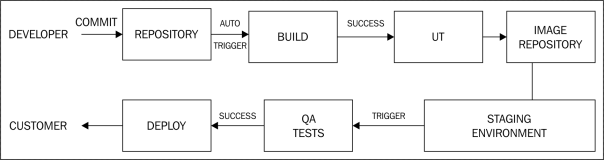
Following are some notes on the above diagram:
Continue reading CI, CD with Docker, Jenkins and Tutum →
 Sreenivas Makam's Blog