Tag Archives: cisco

Openstack distribution

In the last few months, following were some acquisitions that happened: Cisco acquiring Metacloud, EMC acquiring Cloudscaling, HP acquiring Eucalyptus. Metacloud and Cloudscaling have Openstack based distributions, Eucalyptus has a cloud OS similar to Openstack. This set of acquisitions prompted me to look little closely at Openstack distributions and following blog is a result of this.

I see a close parallel between Linux and Openstack in terms of how they are evolving. Unix started off with various flavors like FreeBSD, Solaris, Linux etc. Linux is the dominant Unix version used now. There are different companies like Redhat, Ubuntu selling and supporting Linux distributions. There are currently different Cloud OS like Cloudstack, Eucalyptus, Openstack etc. Openstack is emerging as a major Cloud OS. There are different companies selling Openstack distributions currently.

Continue reading Openstack distribution

Ansible for Network Automation – Part 2

This blog is part of my series on Devops for Networking. In the previous blog, I covered basics of Ansible and how to get started with it. In this blog, I will cover a sample application that I wrote with Ansible. This Ansible application builds on UCS sdk utility that I covered in a previous blog. The UCS python utility displays the inventory of UCS system. I have made that utility as an Ansible module and extended the application to display the inventory of a list of UCS systems that are defined in the host list. This project is more to illustrate the usecase for Ansible.

The source code for the project can be found here. There are 3 files listed here:

getucs.yml - YAML file that defines the playbook
getucsinfo - New module that is defined. This file needs to be in "usr/share/ansible"
getUcsProp.py - getucsinfo module uses functions in this library. This file needs to be in PYTHONPATH.The library provides utility functions to get UCS inventory.

Continue reading Ansible for Network Automation – Part 2

Network device configuration using templates with Jinja2 and YAML

This blog is part of my series on Devops for Networking. Typically, Network device configurations for CLI based systems are stored as text files and when its necessary to change parameters like gateway address, vlan, ntp server etc, the script is manually edited and then reapplied to the device. This process is manual and prone to errors. In this blog, I will cover how to automate generation of configuration scripts using Jinja2 and YAML. I will also provide an sample application that I created. For more details, please refer to the references section below.

Tools overview:

Jinja2:

Jinja2 is a Python library for creating configuration based on templates. Jinja2 defines a templating language with which templates are created. The templates can be as simple as a hostname variable that needs to be updated or it can be an array of vlans that needs to be populated. Jinja2 also provides complex templates to cover different scenarios. Following is a very simple example of a template which says ntp_server is a variable that needs to be updated dynamically. We will see later how we can feed in the dynamic values to update.

ntp server {{ ntp_server }}

Continue reading Network device configuration using templates with Jinja2 and YAML

Cisco device configuration using Netconf

This blog is part of my series on Devops for Networking. In this blog, I will cover how to configure and monitor Cisco NXOS devices using Netconf. In 1 of my earlier blogs, I have provided basics of Netconf and Yang.

I have used Nexus 3k switch for my experiments below.

Netconf has the following layers:

devops8

  • Transport protocol is sshv2.
  • rpc request section contains namespace related details.
  • Operations section could be different operations like edit-config, get-config, commit, lock etc.
  • Content section contains the actual device operation in XML format. The schema for the content can either be specified in XSD format or using Yang. Cisco NXOS devices support XSD format and I will use it in this blog.

Continue reading Cisco device configuration using Netconf

Cisco device configuration using OnePK

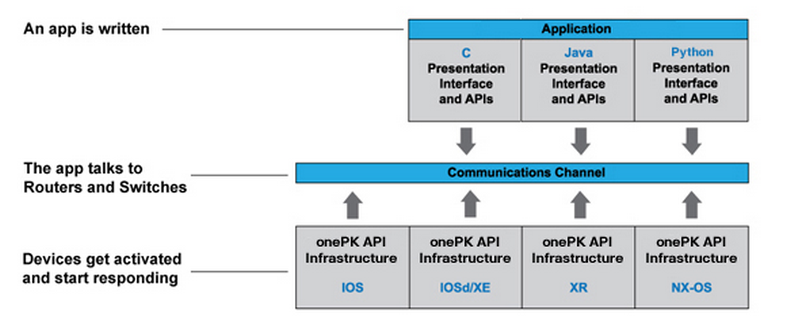
This blog is part of my series on Devops for Networking. onePK is Cisco’s attempt to expose a standard set of APIs to configure and monitor across multiple different Cisco devices. Orchestration and automation applications can use these standard APIs to talk to Cisco devices. In this blog, I will cover a brief overview of onePK and how to get started with onePK to write applications on top of it.

OnePK overview:

Following block diagram from Cisco gives different blocks involved in onePK.

devops6

Continue reading Cisco device configuration using OnePK

Nexus devices CLI parsing using Python, XML and JSON

This blog is part of my series on Devops for Networking. As I indicated in 1 of my earlier blog, majority of Network devices still have CLI as the only means of configuration and monitoring. CLI is not automation friendly because of obvious reasons. In the last few years, Cisco NXOS devices provides CLI output in XML and JSON format. This allows much easier ways to parse the CLI output which aids in automation. In this blog, I will cover some examples of monitoring Cisco NXOS devices using Python interface to interact with the device and get useful information.

Prerequisites:

Continue reading Nexus devices CLI parsing using Python, XML and JSON

Cisco UCS automation using Python SDK

This blog is part of my series on Devops for Networking. In this blog, I will cover a brief overview of UCS management model, management tools and how to automate configuration and monitoring of Cisco UCS using Python SDK. UCS is Cisco’s Unified computing system that provides a tightly integrated compute, networking and storage solution.

UCS Management

Cisco UCS management information model is a hierarchical tree with each node in the tree representing either physical or logical entity. The node is referred to as MO(Managed object). Physical entities could be chassis, servers, switches and logical entities could be policies, service profiles etc. XML based interface is provided to set and get managed objects. Following picture shows a sample Management tree with Chassis, blades and adapters.

Continue reading Cisco UCS automation using Python SDK

DevOps and Network Automation

Devops is now a widely used term. I recently read few articles on Devops in relation to Network Automation and that prompted me to do some research on this topic. In this blog, I will cover what I think comprises the Devops Networking domain and in the next series of blogs, I will try to explore individual areas in more detail. Devops allows infrastructure to be treated as a code and it makes the infrastructure programmable. The term Devops refers to a merger between Development and Operations role and it encourages Developer to look at Operations angle and Network operator to look from Developer angle. As everyone knows, automating infrastructure deployment improves efficiency, removes operator error and allows us to scale. Server automation has been present for quite some time and Network Automation is still very much in infancy stage at this point. Following article from Ivan describes Devops as a lifestyle or mindset on how infrastructure is treated rather than as tools associated with Devops.

How is Network Automation different from Server automation?

Continue reading DevOps and Network Automation

NFV Solutions

This is a continuation from my previous blog on NFV overview. In this blog, I will cover popular NFV solutions in the market. This is not an exhaustive list, these are the NFV solutions that I am aware of. Following are the ones that I will cover:

  • Cisco Evolved services platform(ESP)
  • Alcatel-Lucent Cloudband
  • CloudNFV
  • Overture’s Ensemble OSA

Continue reading NFV Solutions

Cloud policy – Congress and Opflex

Recently, I saw a lot of press on Cisco’s Opflex protocol that allows a declarative policy model to control a physical or virtual device. There were discussions around if the Opflex protocol would replace Ovsdb and Openflow. Within Openstack, there is a new project called Congress that allows for creating a policy framework within Openstack. This blog is my attempt to get into more details on Congress and Opflex and explain the relationship between them. This is mostly information gathered from different references that I have listed in the end.

Congress:

Congress is a new Openstack project that is used to enforce compliance within the cloud environment. The end goal would be to integrate Congress with other cloud orchestration software as well. Compliance could be needed because of Government regulations, contracts between organizations, SLA enforcement etc. Following picture illustrates the need for Congress.

Continue reading Cloud policy – Congress and Opflex